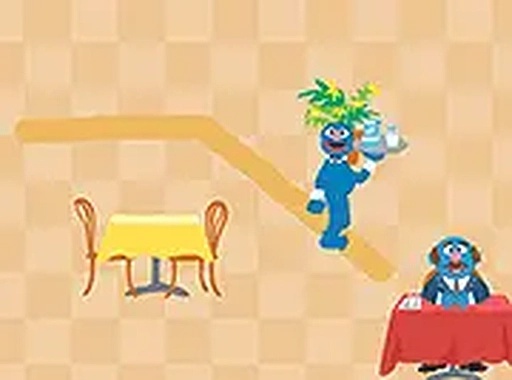
Path Drawing as Core Interaction
Each round presents a diner floor with a waiter named Sesame, a kitchen, and customers waiting at tables. Your job is to draw a continuous line from the kitchen to a specific customer. That line becomes Sesame's walking route. The catch: the floor is littered with obstacles like spilled food, chairs, and counters. If your drawn path crosses any of them, Sesame drops the meal and you lose one of your chances. The game rewards precision over speed when you first start, because a single collision costs you a delivery attempt.
Obstacles and Spatial Awareness
Obstacles are not decorative; they define the puzzle. Spilled food and furniture block direct routes, forcing you to trace around them. Early levels have wide open spaces, so a straight line often works. As you progress, the diner gets messier and more crowded. You will need to read the floor layout before drawing, spotting narrow gaps and alternate routes. The challenge comes from planning a path that is both collision-free and short enough to beat the clock.
Time Pressure and Progression
A timer runs during each level. You must serve every customer before it hits zero. Successful deliveries earn points and unlock new stages. Later levels introduce more customers and tighter time limits, so the same path that worked earlier may now be too slow. The difficulty curve is gentle but steady: you are never asked to learn a new control, only to apply the same drawing skill under greater pressure. This makes the game accessible to beginners while still offering a light challenge for experienced players.
Controls and Platform
Everything is controlled with a mouse or a finger. You draw directly on the screen, and the game interprets your line as Sesame's route. There are no buttons to memorize or complex combos. The game runs in a browser on both mobile and desktop, with no download or registration required. That pick-up-and-play design means you can start a level in seconds, which suits short breaks or casual sessions.










Comments
0 comments