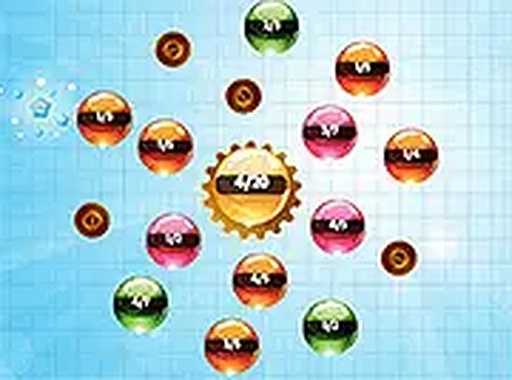
How Fraction Matching Works
Each round places a fraction at the center of the screen. Around it, several markers travel along a circular path, and every marker carries a different fraction. The player's job is to identify which orbiting fraction equals the central value. A correct pick moves the player forward; an incorrect one does not advance the round. This turns fraction equivalence into a quick visual comparison task rather than a written worksheet problem.
Difficulty Curve Across Rounds
The game starts with obvious matches, such as one-half paired with two-fourths. Later rounds introduce less direct equivalents, including three-sixths equaling one-half, and then more complex combinations. Because the challenge grows gradually, players meet harder comparisons only after the simpler ones are familiar. That pacing is the main progression system in Math Matching Orbits.
Controls and Device Support
Math Matching Orbits runs in a web browser on smartphones, tablets, and desktop computers. Touch controls are tuned for mobile screens, and a full-screen mode cuts down on visual distractions. Nothing needs to be installed, and no account creation is required, so a practice session can start immediately on almost any device with a browser.
Visual Attention and Engagement
The orbiting motion adds a tracking demand. Players must follow moving targets while holding the central fraction in mind. Combining mental calculation with visual attention keeps short sessions engaging and makes the activity feel closer to a game than to a standard lesson. The design suits brief, repeated practice rather than long play periods.







Comments
0 comments