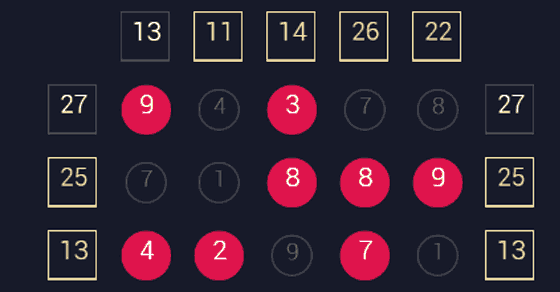
How the Grid Works
Each puzzle in Sum Grid Challenge hands you a grid of numbers plus a target sum for every row and column. Your job is to nudge individual cells until each horizontal and vertical line equals its goal. Tapping a number raises it by one; holding lowers it by one. That two-gesture control scheme is the entire input method, which keeps the focus on arithmetic rather than on learning a complex interface.
Adjusting Numbers Without Pressure
There is no timer and no penalty for experimenting. Every tap or hold updates the grid instantly, so you can see immediately whether a change pushes a row closer to its target or throws off a column you already fixed. This immediate feedback turns each puzzle into a loop of small adjustments and quick checks. Because you can restart a puzzle or switch to another at any moment, a wrong guess costs nothing except the seconds it takes to undo it.
From Small Grids to Complex Targets
Early puzzles use small grids so the rules become obvious within a few moves. As you complete more puzzles, larger grids and more intricate target combinations appear. The difficulty climbs gradually rather than in sudden spikes, and earlier puzzles remain available for practice whenever a new layout feels overwhelming. That structure gives newcomers room to build confidence while still offering tougher arithmetic for players who want it.
Progress, Pace, and Mental Arithmetic
The game records completed puzzles and tracks improvement over time, which gives regular play a sense of continuity. Sessions can be as short as a single grid or as long as you like, since nothing forces you to finish a puzzle before leaving. The arithmetic involved is basic addition and subtraction, but the row-and-column constraints require you to think about how one number affects multiple sums at once. That makes the game useful for children practicing mental math and for adults who want a low-stakes numerical workout.






Comments
0 comments