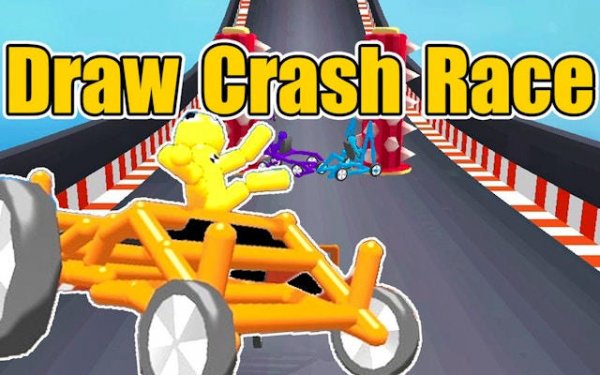
Designing a Car That Moves
Every run in Creative Car Builder Racing begins with a blank canvas. Using a mouse or touchscreen, you draw the chassis shape, then attach wheels and a driver's seat to complete the vehicle. The game does not tell you the optimal shape or wheel placement. Instead, it lets you commit to a design and see what happens. That freedom is the point: the drawing tool is the main creative decision, and the track is where you find out if your choices hold up.
Physics on Elevated Tracks
Once you launch, the car moves on its own. You do not steer or accelerate. The physics simulation takes over, bouncing the vehicle across obstacles, jumps, and rough terrain. A wide, balanced base with evenly spaced wheels tends to resist tipping, while a tall or narrow frame often flips on the first hard landing. Because the car is not manually controlled, the outcome depends almost entirely on how well you anticipated the track's demands during the design phase.
Learning Through Each Attempt
Failure is informative here. After a run ends, you can review what went wrong and adjust the design before trying again. Adding too many parts can make the car fragile, so simple builds often outperform complicated ones early on. Repeating the same track helps you identify which obstacle caused the problem, whether it was a steep drop, a gap, or a landing angle. Over time, you build an intuitive sense of how shape, weight distribution, and wheel size affect performance.
Who This Game Suits
Creative Car Builder Racing is a casual experience built around experimentation rather than reflexes. The drawing and launch controls are simple enough for younger players, but the underlying physics gives older players something to refine. If you enjoy tinkering, testing ideas, and learning from failure, the loop of design, race, and redesign stays engaging across multiple tracks.










Comments
0 comments