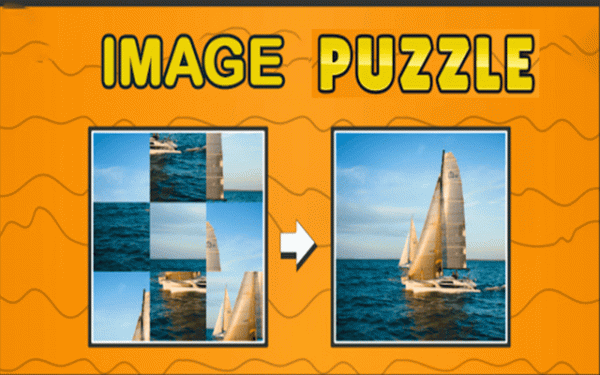
Core Swap Mechanic
The puzzle drops you into a scrambled image and asks one thing: put it back together. You do that by clicking or tapping a tile to select it, then swapping it with a neighboring tile. There is no dragging, no rotating, and no hidden moves. Every action is a direct exchange between two adjacent pieces. That constraint is what makes the game feel like a logic exercise rather than a freeform jigsaw. Because each swap affects two positions, you quickly learn to plan two or three moves ahead instead of reacting one tile at a time.
Grid Sizes and Difficulty
Two grid options are available: a 3x3 layout for a quicker solve and a 4x4 layout for more complexity. The difference is not just the number of tiles. On a 3x3 grid, you can often hold the whole arrangement in your head and work intuitively. On a 4x4 grid, the extra pieces make it harder to track where each tile belongs, so you need a more systematic approach. Starting on 3x3 lets you internalize the swap rules before the 4x4 grid forces you to think in sections.
Using Built-In and Personal Images
The game includes a library of images to choose from, and it also accepts your own photo uploads. That second option changes how you approach a puzzle. A familiar photo gives you stronger visual anchors because you already know what the finished picture should look like. An unfamiliar image from the library tests pure spatial reasoning. Switching between the two keeps the game from feeling repetitive, since the challenge comes from the picture as much as the grid size.
Timer and Progress Tracking
A timer runs while you solve and records your completion time. It does not pressure you with a countdown or fail state; it simply gives you a number to compare against your previous attempts. That makes the game easy to play casually while still offering a reason to return. If you want to improve, the timer turns each solve into a measurable attempt rather than a one-off distraction.
Practical Solving Approach
Rather than trying to fix the whole image at once, focus on one region, such as a corner or an edge, and complete it before moving on. This limits how many tiles you need to track at any moment. On the 4x4 grid especially, finishing a section gives you a stable reference point for the rest of the board. Regular practice sharpens pattern recognition, and the timer gives you a clear way to see whether that practice is paying off.









Comments
0 comments